
"If I am not evolving, I am a dead guy"
The connection crackles slightly, Dhritiman Mukherjee is calling from the Andaman & Nicobar Islands, deep in the forest with the local forest department, exploring terrain that most will never witness. His voice carries that particular quality of someone who's just spent hours watching something the rest of us would miss entirely: alert, present, still processing.
For Mukherjee, one of the world's most celebrated wildlife photographers, evolution isn't biological. It's philosophical. Every belief, every approach, every way of seeing is shaped by surroundings that never stop changing. "Your environment, your situation, they shape your way of seeing," he explains. "What was then, is not now."
This isn't casual relativism. It's hard-won wisdom: ideology must remain fluid or it calcifies into dogma. And dogma, in his view, is death not physical death, but creative death, the kind where you keep breathing but stop truly seeing.

"The journey never ends," he says, and it's not platitude. "I always arrive with questions… and leave with more." That humility; genuine recognition of the expanding perimeter of his own ignorance is rare in accomplished people. The more he photographs, the more he understands how little he actually knows.
Picture him before the shot, not seconds, but hours, sometimes days of waiting. Dawn over a Himalayan ridge. A predator stalking through tall grass. A migration pattern invisible to everyone who hasn't learned to read landscape like language. The camera is ready. He is not. Because readiness isn't technical preparation. It's the internal state where ego dissolves enough that the frame can reveal something beyond his expectations.
He asks himself one question before every frame: What am I trying to say with my visual communication? Photography, for him, isn't about aesthetics alone. It's about intent; a constant search for meaning that keeps evolving, just as he does.
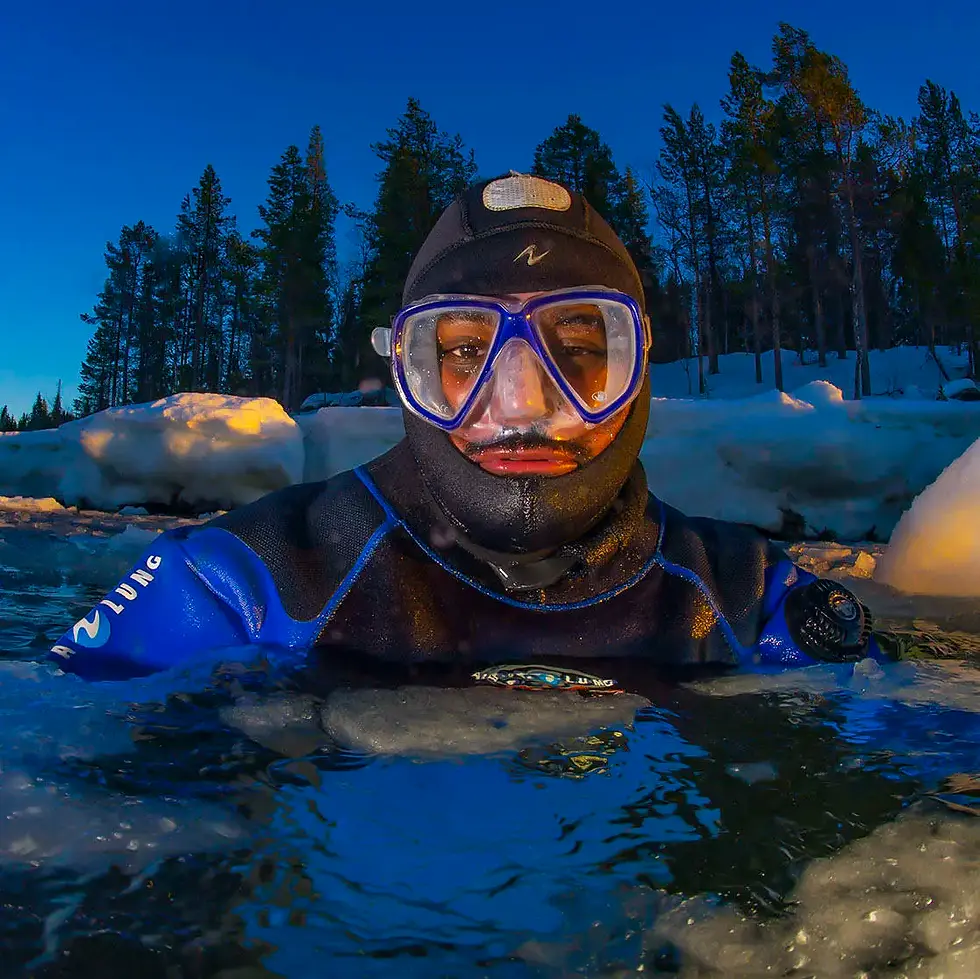

"See what has been done before and don't do it again," he insists, and suddenly you understand why his work carries such weight in a world drowning in images. Every habitat has been photographed a thousand times. The challenge isn't finding something new to shoot. It's finding a new way to see what's always been there.
"Open your senses. Do something new." But new doesn't mean novelty for its own sake, some gimmick drawing attention to the photographer rather than subject. New means seeing differently. "What sets us apart from others," he says quietly, "is what defines us."
Every click becomes an act of consciousness. Every frame an extension of his evolving ideology, which itself is shaped by his evolving environment, which requires constant questioning or dies.
When conversation shifts from craft to life, that broader canvas where everyone must find their framing, his words slow. More reflective than didactic. "I've gone through problems," he admits in the understated way people who've actually suffered acknowledge pain. "But the end goal is always to stay happy."

"It's not in the control of the world," he continues. "At first, I used to think, how do I get out of problems? But later, I realized… I had to change my perspective." He invokes Tagore's parable: the man searching for shoes to protect his feet from the world's roughness, before understanding he must cover his own soles instead of attempting to pave the entire earth.
"For our happiness," Mukherjee says, "we try to work on the world when we should work on ourselves." It's the photographer's insight applied to life; you cannot change the landscape, only your position within it. You cannot control the light, only your relationship to it.
This philosophy extends to how he thinks about blame. "Blaming divides," he says simply. "From societal, it becomes personal." His approach is rooted in acceptance, in seeing life as continuum rather than victories or mistakes.
Asked what he'd tell his younger self, he pauses longer than expected. "I would've stopped my friend from his accident," he says, voice dropping. Then, firmer: "But I won't share anything else, I want him to experience life the way I did."
It's startling; not because it's sentimental, though the grief is palpable, but because it reveals his evolution philosophy's logical endpoint: If experience shapes perception, then removing experiences would rob him of the very material that taught him to see. Even the painful ones. Especially those.


"I never want to say, you should do this," he clarifies. "I can only say, this is what I follow. I am not authority." Rare humility in someone whose work hangs in museums, whose images have shaped conservation efforts. But the humility isn't false modesty. It's structural to his entire philosophy. Authority requires fixed knowledge. His approach requires perpetual unknowing.
Currently working on an OTT series alongside his Andaman exploration, Mukherjee continues expanding how his work reaches audiences. But what remains constant isn't his medium or subjects; it's his restless curiosity, that fundamental unwillingness to settle into certainty about anything.
The wild, for Mukherjee, is not just his subject. It's his teacher. Every encounter with untamed spaces is simultaneously an encounter with the untamed parts of himself; the parts that resist domestication into fixed ways of knowing, the parts that remain curious despite decades of experience.
"The journey never ends," he says again, and this time you hear it as mantra. Not inspiration. Simple fact. The journey doesn't end because the moment you stop moving' intellectually, creatively, ideologically' you've stopped being alive in any way that matters.


To know the world, Mukherjee's work suggests, you must first unlearn your certainty. The rest will reveal itself through wonder. Not the cheap wonder of novelty, but the profound wonder of someone who's looked at the same landscape a thousand times and still believes it has something new to teach him.
The question isn't what he sees that we don't. It's what he's willing to unlearn that we aren't. What certainties he's abandoned that we still clutch. What ideologies he's evolved past while we remain static, mistaking our stasis for conviction.
The truest seeing, his life suggests, begins with knowing what to leave unseen. And perhaps that's why he's still out there, in the Andaman forests, camera ready but patient, waiting for the moment that reveals not just the world, but a new way of looking at it.
Also Read
.png)
Rajneel Kumar
Arguably one of the most influential men in the world of Lights & Camera - This legend is more than just a technician; He is an artist.

Neil Sadwelkar
Curiosity may have killed the cat, but Dhritiman was there to document it. An explorer with the DNA for discovery makes him the ultimate.

Kalpesh Damani
Perceived reality, Designed consciousness. She is a master at her craft but leads with the heart of a gentle soul - keeping her ethos always at core.